Monday, February 16, 2009

The race is on!

Hummingbird migration is about to hit the United States, so make sure to get your hummingbird feeders out and ready for the hungry travelers!

Hummingbirds are indigenous to the Americas (although they are amazing aviators the oceans are too vast to make it into Asia or Europe and Africa). There are a total of 16 species of hummers in the U.S., some in the western states will winter in Arizona and Southern California. Species that stay in the southwest include: Anna, Costa's, and Allen's hummingbirds. The other 13 species all migrate through our country; 12 on the western side of the Mississippi River and 1 very special bird on the eastern side of the Mississippi River.

One of the most spectacular migrations in the world, the Ruby-throated hummingbirds make their way across the Gulf of Mexico from South America into and through the United States and Canada.

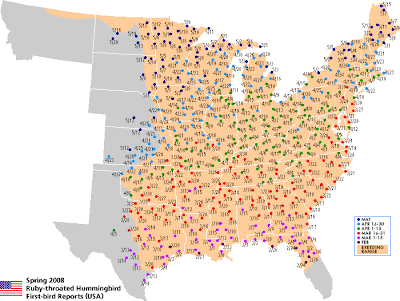
Every Spring, urged on by instinct, thousands upon thousands of Ruby-throated hummingbirds start appearing in the Gulf States and fill into the mid-Atlantic and mid-western areas of the U.S. They start to be seen in eastern Texas and southern Florida in February (the earliest visitors were seen February 24th last year!)

Here's a small picture of the Ruby-throated hummingbirds migration pattern from 2008 (for a full view visit http://www.hummingbirds.net/map.html). On the map you'll be able to locate the first sitings of hummingbirds in your state - thanks to over 5,000 other hummingbird enthusiasts' like you!
Wednesday, February 11, 2009

All Creatures Small and Smaller

When it comes to hummingbirds the old saying "good things come in small packages" perfectly describes the diminutive birds' appeal. Hummingbird size is one of the most amazing qualities of the species, as it's hard to imagine so much ability coming from such a small aviator.

I remember going on school field trips to the zoo and getting to see hummingbird eggs (about the size of my pinkie fingernail) and thinking "they're so teeny!" Learning from the zoologist about their flying backwards, "drinking" from flowers, and of course their stunning plumage it was obvious I was going to love these birds always.

When you think of a hummingbird the picture that probably pops in your head is the Ruby-throated hummingbird. It's the archetypal image, the hummingbird you'll see on most t-shirts, mugs, postage stamps, greeting cards, you name it. The Ruby Throat is the most recognized hummer, especially since for most the U.S. (every state east of the Mississippi River) it is the only hummingbird you'll see flying around.

The Ruby-throated hummingbird is one of sixteen species that breed and live/migrate in the United States, but its migration keeps them on the eastern side of The States. If you live on the western side, there are so many other hummers to acquaint yourself with - and we'll start introducing you to these not-so-known wonders! Watch this blog for more info!

Of course outside the U.S. there are even more spectacular species, especially in South America, all which have mind-boggling characteristics. Here are some more exotic species and some cool fast facts:
  • The Bee Hummingbird (the smallest BIRD in the world - not just hummingbirds) lives in Cuba and is literally the size of a bumblebee. Small!

  • The Giant Hummingbird lives in South America and can reach up to 8 inches in size. That's smaller than most songbirds but a true Giant amongst hummers!

  • The Marvellous Spatuletail from Peru (as seen in the John Gould illustration below) only has four tail feathers. Males have two feathers that swoop to bright violet medallion ends, and they can move these feathers independently!

Thursday, January 29, 2009

A moth in hummingbird's clothing

Nature is full of trickery. There are plants that look like animals, animals that look like plants, and a million different camouflages and patterns to keep predators away. The great impostor in the hummingbird world is the hummingbird moth (also called bee months in Europe where hummingbirds do not live).

If you live in the United States and are amazed to see the tiniest hummingbird in your garden, chances are you're really seeing the hummingbird moth. Often mis-sited as the Bee Hummingbird (the world's smallest bird - found in Cuba only), the hummingbird moth has the look and behaviour to fool the sharpest eye into thinking it's a miniature hummingbird.


One of the tricks of the hummingbird moth, unlike other moths, is that it thrives and feeds in daylight. They live on nectar, similar to hummingbirds, and will hover over the same flowers hummers like (honeysuckle, trumpet vine, lilac, bee balm, etc). They extract the nectar through their proboscis, which combined with their body length and coloring, is easily confused as a beak.

Hummingbird moths have similar colors in their bodies as hummingbirds, but their pattern differences are the dead-giveaway. Moths like the Clearwing Hummingbird Moth (pictured above) have red/brown bands across their abdomens, and there are tufts of hair that look feather like. Hummingbirds don't have stripes like these, instead their color is typically concentrated on their throat, wings, sometimes with solid iridescent color on their back.

Hummingbirds are also much more skittish than their aping moths. Chances are you'll be able to sneak up on a moth but not a true hummer.

Although the idea of "baby" or Bee hummingbirds in your garden maybe exciting, if you do see a hummingbird moth instead don't be disheartened. They are truly fascinating creatures and still fun to watch flitting from flower to flower. And the fact that you're attracting another nectar-loving creature to your yard is a positive! Maybe one morning you'll be happily surprised by a real hummer visit.

Hummingbird in Napa, CA